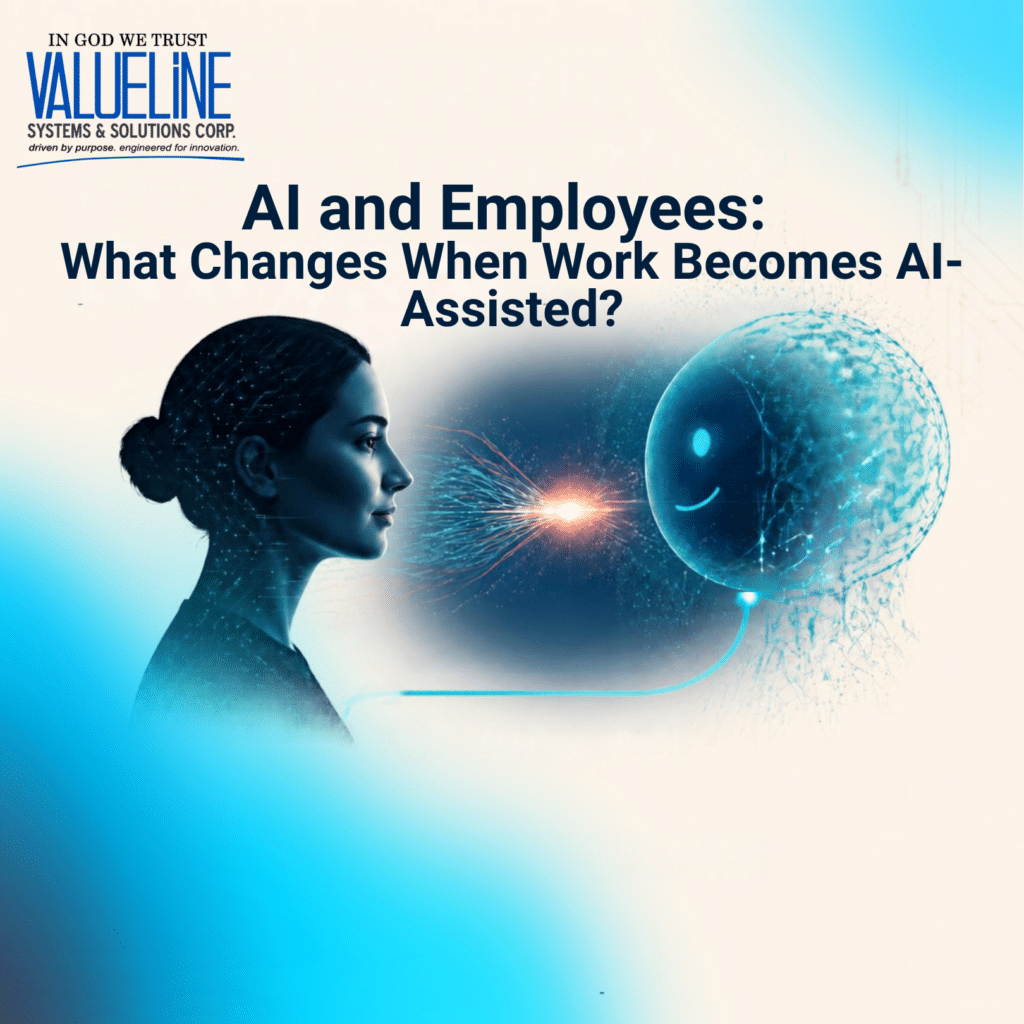
AI and Employees: What Changes When Work Becomes AI-Assisted?
Valueline Insights | AI and the Future of Work
Artificial intelligence has quickly become part of the way businesses work. From generating content and analyzing data to assisting with software development and automating repetitive tasks, AI is no longer something we can simply treat as a future possibility. As we speak, AI is already here, and it is changing how work gets done.
And with that comes a question that continues to be asked:
Will AI replace employees?
This is a valid question, especially now that people are becoming more aware of what AI can actually do. But perhaps the more useful question for businesses is:
What changes when work becomes AI-assisted?

AI Is Changing the Way Work Gets Done
AI can handle tasks that are repetitive, time-consuming, and heavily dependent on processing information. It can summarize documents, identify patterns in data, generate initial drafts, assist with customer inquiries, and help employees complete routine processes.
But if we really think about it, a job is rarely just one task. There are different responsibilities that come with every role.
A marketer does more than create content. An HR professional does more than process employee information. A developer does more than write code. And a customer service representative does more than respond to questions.
There is context. There is judgment, communication, creativity, accountability, and decision-making.
And this is where the idea of AI augmentation becomes important. Instead of looking at AI only as something that replaces people, businesses can also look at how AI can help employees spend less time on repetitive work and more time on the things that require human judgment.
So, What Does AI Augmentation Actually Look Like?
Let's take customer service as an example.
AI can help summarize customer conversations, organize information, identify common concerns, or suggest possible responses. But the employee is still there to understand what the customer actually needs, determine the appropriate response, and make sure the issue is properly resolved.
And this does not only apply to customer service.
Marketing: AI can help with research, content ideas, and data analysis while marketers focus on strategy, customers, and brand direction.
Human Resources: AI can assist with administrative tasks and routine inquiries while HR teams focus on employee experience, policies, and people management.
Finance: AI can help identify patterns or unusual activity in financial data while finance professionals interpret the information and make decisions.
IT: AI can assist with documentation, troubleshooting, monitoring, and development while IT teams focus on architecture, security, and business requirements.
The goal is not simply to make people work less. It is about helping people spend more of their time on work that creates value.
What Does This Mean for Philippine Businesses?
This conversation is especially relevant here in the Philippines.
According to the International Labour Organization, more than one-quarter of employment in the Philippines, around 12.7 million jobs, has some exposure to generative AI. Now, that number might sound alarming at first.
But exposure does not automatically mean that these jobs will disappear. The ILO estimates that only 3.6% of jobs fall into the highest GenAI exposure category associated with elevated displacement risk. The larger impact is expected to come from how jobs change and how tasks within those jobs are performed.
And this distinction matters.
A business may not need to replace an entire role just because AI can perform one part of it. Instead, the business can look at the workflow and ask:
What can AI handle, and where do we still need people?
AI can take care of certain repetitive tasks while employees focus on more complex responsibilities. For Philippine businesses, this can create an opportunity to use technology not only to reduce costs, but also to improve productivity, service quality, and the value employees can provide.
But AI Will Not Replace the Need for People
Of course, this does not mean that AI will have no impact on employment. Some tasks will become automated. Some roles may change significantly. And some jobs may face greater displacement risks than others.
The World Economic Forum's Future of Jobs Report 2025 reflects this broader shift. Its employer survey projects both job creation and displacement by 2030, while also pointing to a growing role for human-machine collaboration.
So, it is not necessarily a matter of automation or augmentation. Both can happen at the same time. As technology becomes capable of handling more tasks, employees may also need to develop new skills and take on responsibilities that technology cannot easily provide.
This is why AI adoption should not be treated as simply a technology project. It is also a people and process transformation.
The Human Side of AI Still Matters
AI can process information quickly, but businesses still need people to provide context and accountability.
Who makes the final decision?
Who checks whether an AI-generated answer is appropriate?
Who understands the customer beyond the available data?
Who determines whether an AI recommendation actually makes sense for the business?
These questions matter because AI can produce useful outputs, but it can also produce errors, biased results, or information that may not be appropriate for the situation. NIST's AI Risk Management Framework emphasizes the importance of clearly defining human roles and responsibilities when organizations use AI systems. It also highlights the need to consider the limitations and risks involved in human-AI interactions.
So, when businesses think about AI adoption, the question should not only be:
“Which AI tool should we use?”
It should also be:
“How are we going to use it responsibly?”
Businesses need to consider who will oversee the technology, what data it can access, how it will be used, and where human judgment should remain part of the process.
The Real Opportunity Is Redesigning Work
Instead of asking only:
“Which jobs can AI replace?”
business leaders can also start asking:
• Which repetitive tasks can we automate?
• Where can AI help employees work faster?
• Which processes can be improved with AI?
• What decisions should remain human-led?
• What skills will our employees need as AI becomes part of their work?
• How can we use AI without losing accountability and trust?
These questions lead to a more practical way of looking at AI adoption. The objective is not simply to introduce AI because everyone else is doing it. The objective is to identify where AI can actually improve the way the business works.
AI Adoption Requires More Than a Tool
Implementing an AI tool does not automatically create better results. Businesses still need the right data, processes, infrastructure, security measures, governance, and people to support it. And employees need opportunities to understand and use these technologies effectively.
This is where upskilling becomes important. The World Economic Forum reports that 77% plan to implement reskilling/upskilling of existing workers to work more effectively alongside AI, while 41% plan to reduce their workforce as AI automates certain tasks. For organizations, this means AI adoption also comes with a responsibility to prepare their people. AI can simply be used to automate existing processes. Or businesses can take a step back, rethink those processes, and see how AI can help employees work in new and more productive ways.
So, What Changes When Work Becomes AI-Assisted?
AI will change the way many people work.
Some tasks will become automated. Some roles will evolve. New skills will become more important. And organizations will need to rethink how technology fits into their existing processes. But looking at AI only through the lens of replacement misses a much bigger part of the conversation.
For many businesses, the opportunity is not necessarily AI instead of people. It is AI working with people. The organizations that approach AI thoughtfully can use it to reduce repetitive work, support better decisions, improve productivity, and give employees more time to focus on work that requires creativity, judgment, collaboration, and human connection.
The future of work is not simply about choosing between humans and technology. It is about understanding where technology works best, where people work best, and how the two can work better together. The question is no longer simply whether AI can replace employees. The better question is:
What becomes possible when employees have AI to work with?
Frequently Asked Questions
Will AI replace employees?
AI may automate certain tasks and change some roles, but exposure to AI does not necessarily mean that an entire job will be replaced. For many roles, AI is more likely to change how work is performed by assisting employees with specific tasks.
What is AI augmentation?
AI augmentation refers to using artificial intelligence to assist employees with tasks such as research, analysis, content generation, information processing, and automation while people remain responsible for judgment, decision-making, and accountability.
How is AI changing the workplace?
AI is changing the workplace by automating repetitive processes, analyzing information, supporting decision-making, and helping employees complete certain tasks more efficiently. As these changes continue, employees may also need to develop new skills.
Should businesses automate everything they can with AI?
Not necessarily. Businesses should identify where AI can create meaningful value while also considering data security, governance, human oversight, customer impact, and the effect on employees and business processes.
What skills will employees need as AI becomes more common?
AI literacy will become increasingly useful, alongside critical thinking, communication, creativity, problem-solving, and the ability to work effectively with AI tools.
How should Philippine businesses approach AI adoption?
Businesses can start by identifying specific processes where AI can improve productivity or employee experience, then establish appropriate data, security, governance, training, and human-oversight practices before scaling adoption.
Other News & Updates: