ValueHRIS: How a Healthcare Staffing Company Streamlined Complex HR and Payroll Operations
Valueline Insights | HR Technology & Workforce Transformation
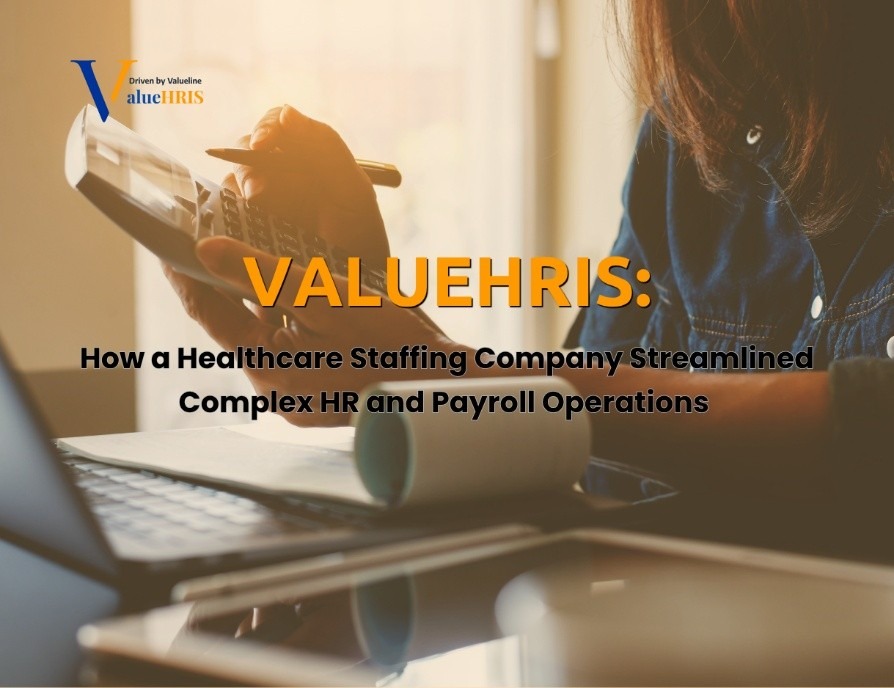
A healthcare staffing company in the Philippines streamlined complex attendance, payroll, and tax processes with a configurable HRIS designed around its workforce requirements.
Managing HR and payroll becomes significantly more challenging when employees work different shifts, operate across multiple locations, and follow non-standard payroll schedules. For a growing healthcare staffing company in the Philippines, these challenges were becoming part of everyday HR operations.
The organization managed employees working regular office hours, extended shifts, afternoon shifts, and flexible schedules. Its HR team also had to manually validate attendance adjustments before payroll processing while working around a fiscal year that runs from December to November for 13thmonth pay computation.
The company needed more than a standard HRIS. It needed a flexible HR and payroll system that could adapt to its existing policies and workforce structure. That is where ValueHRIS came in.
The Challenge: Managing Complex HR and Payroll Requirements
As the company grew, its HR processes became increasingly difficult to manage manually. The organization needed to accurately track attendance across different employee schedules while ensuring that payroll reflected actual attendance, overtime, absences, and other adjustments. Its previous HRIS presented another limitation: fixed payroll cutoff settings. Because the system could not easily accommodate the company's existing payroll process, HR personnel often needed to conduct additional manual checks before payroll could be finalized. The company also had a unique requirement for 13th-month pay computation. Rather than using a traditional January-to-December calendar, its fiscal year runs from December to November. The organization therefore needed an HRIS that could accommodate its payroll calendar without relying on spreadsheets, manual calculations, or extensive custom development.
At the same time, the company wanted to modernize how employees recorded attendance.
Its requirements included:
• Multiple shift schedules for a 24/7 workforce
• Flexible work arrangements
• Biometric attendance
• Online attendance through employee self-service
• Geo-tagged time logging for remote employees
• Web and mobile access
• Automated tax computation and annualization
• BIR Form 2316 generation
• Support for Philippine payroll requirements
The goal was clear: create a more efficient HR and payroll process without disrupting the company's existing operations.
Why Healthcare Staffing Companies Need Flexible HR Technology
Healthcare staffing organizations face HR requirements that can differ significantly from traditional office-based businesses. Employees may work extended shifts, afternoon schedules, flexible arrangements, or other schedules based on operational requirements. When these schedules are managed manually, attendance monitoring and payroll processing can become increasingly time-consuming. A flexible HR system can help organizations centralize these processes while reducing repetitive administrative work. More importantly, the system needs to accommodate the organization's existing policies and payroll structure rather than requiring HR teams to work around rigid system limitations. For this healthcare staffing company, flexibility was a key requirement.
The Solution: ValueHRIS
To address these challenges, the company implemented ValueHRIS, a configurable HR and Payroll solution designed to support its existing policies and workforce structure. Rather than requiring the company to completely change how it manages HR, ValueHRIS was configured around its operational requirements.
1. Multiple Shift and Schedule Management
ValueHRIS supports multiple employee schedules, making it suitable for organizations with different work arrangements. The healthcare staffing company can manage regular office hours, extended shifts, afternoon shifts, and flexible schedules within the same system. This provides HR with a centralized view of employee attendance while supporting the operational requirements of a 24/7 workforce.
2. Flexible Attendance Tracking
Employees can record attendance using biometric devices or the employee self-service portal. For remote employees, geo-tagged time logging is available through the web and mobile applications. This gives the organization greater flexibility in managing attendance across different work environments while maintaining a centralized attendance record.
3. Configurable Payroll Cutoff Periods
Payroll processes are not always the same from one organization to another. ValueHRIS allows payroll settings to be configured according to the company's established payroll policies and cutoff periods. This allows attendance adjustments including late arrivals, absences, and overtime to be incorporated into the payroll process more systematically. As a result, HR teams can reduce repetitive manual checking and spend less time reconciling attendance information before payroll processing.
4. Support for a December-to-November Fiscal Year
One of the company's most important requirements was its December-to-November fiscal year for 13th-month pay computation. ValueHRIS was configured to accommodate this payroll calendar without requiring additional custom development. This allowed the company to maintain its existing approach while reducing the need for manual computations.
5. Automated Tax Processing and BIR 2316 Generation
Year-end payroll processing can create significant administrative work for HR teams. ValueHRIS supports annualization and tax computation, helping streamline the process and reduce manual calculations. The system also supports BIR Form 2316 generation, helping HR teams simplify the preparation of employee tax documentation
The Results: More Efficient HR and Payroll Operations
With ValueHRIS implemented, the company was able to bring key HR processes together within one platform.
The solution helped the organization:
Support multiple shift schedules
Manage different work schedules for a 24/7 workforce through a centralized system.
Reduce manual payroll checking
Minimize repetitive validation during payroll processing by aligning attendance and payroll settings
with company policies.
Improve attendance and payroll accuracy
Create a more structured process for capturing attendance and incorporating attendance data into
payroll.
Accommodate its unique fiscal year
Support a December-to-November fiscal year for 13th-month pay computation without additional
customization.
Simplify annual tax processing
Reduce manual work associated with annualization, tax computation, and BIR Form 2316
generation.
Centralize employee services
Provide employees and HR teams with a single platform for attendance, payroll, and employee selfservice.
What This Means for Growing Organizations
The challenge faced by this healthcare staffing company is not unique. As organizations grow, HR processes often become more complicated. More employees can mean more schedules, more attendance records, more payroll adjustments, and more administrative work.
A scalable HRIS should therefore do more than store employee information. It should help organizations automate repetitive processes, centralize workforce data, support different work arrangements, and adapt to existing business policies.
For companies operating in the Philippines, payroll technology should also be capable of supporting applicable local payroll and tax requirements.
The right HRIS can help HR teams spend less time reconciling spreadsheets and manually checking records and more time focusing on workforce management and employee experience.
From Complex HR Processes to Smarter Workforce Management
The healthcare staffing company's experience demonstrates an important principle in HR technology:
Your HR system should adapt to your business not force your business to adapt to the system. With configurable attendance, payroll, employee self-service, and tax-related functionality, ValueHRIS helps organizations create a more connected approach to workforce management. Whether you are managing a growing workforce, multiple shifts, remote employees, or complex payroll requirements, the right HR technology can help your HR team operate more efficiently.
Ready to Upgrade Your HR Operations?
Discover how ValueHRIS can help simplify attendance, payroll, employee management, and other HR processes through one centralized platform.
Talk to our team today to explore how ValueHRIS can fit your organization's HR requirements.
ValueHRIS - Simplify HR. Empower People.
References
• Department of Labor and Employment (DOLE). 13th-Month Pay.
• Department of Labor and Employment (DOLE). Labor Standards and Related Issuances.
• Social Security System (SSS). Contribution and Benefit Guidelines.
• Philippine Health Insurance Corporation (PhilHealth). Premium Contribution Guidelines.
• Home Development Mutual Fund (Pag-IBIG Fund). Membership and Contribution Guidelines.
• National Privacy Commission (NPC). Data Privacy Act of 2012 and Personal Data Protection
Guidelines.
Note: Payroll, tax, and BIR-related configurations should be implemented based on the organization's
applicable policies and current Philippine laws and regulations.