What Is AI? How Artificial Intelligence Works and Where Businesses Can Get Started
Valueline Insights | AI & Digital Transformation
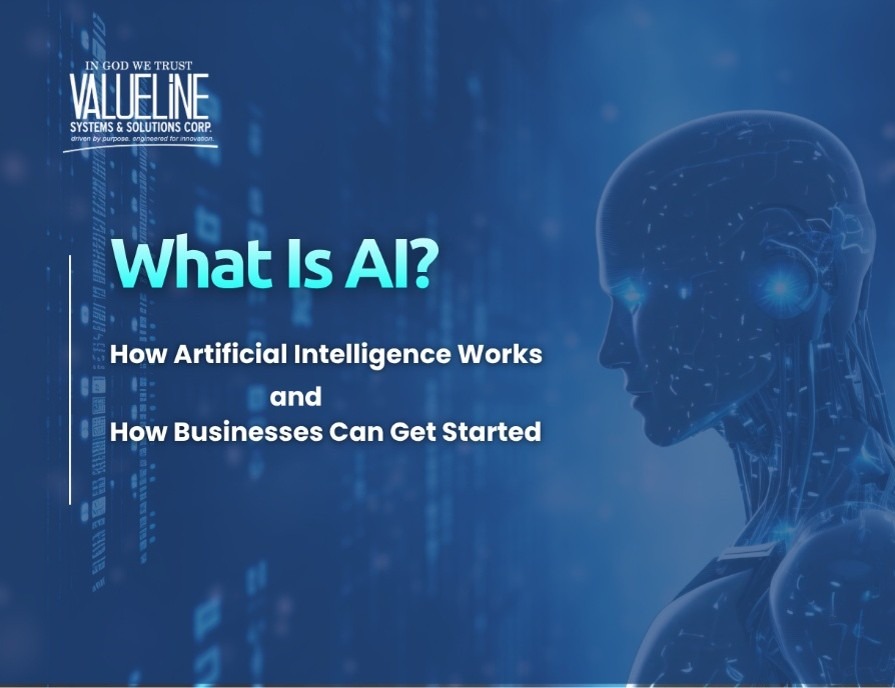
Artificial intelligence (AI) is a branch of computer science that enables machines and software to perform tasks that typically require human intelligence such as understanding language, recognizing patterns, analyzing data, and making recommendations. Rather than replacing human judgment, AI functions as a powerful tool to automate complex processes and turn massive amounts of data into actionable insights.
Artificial intelligence has moved quickly from something we mostly heard about in technology discussions for quite some time to something businesses are actively exploring. We see it in customer service, content creation, data analysis, automation, cybersecurity, and many other areas.
That creates a lot of excitement, but it also creates a practical question for businesses: Where do we actually begin? How can we begin?
It can be tempting to start by looking at the latest AI tool or platform. But we believe the better starting point is the business itself. Look at the business: What is taking too much time? Where are people doing repetitive work? What information is difficult to analyze? What could be improved for customers or employees?
Before answering those questions, it helps us understand the technology behind it. So, what exactly is AI, how does it work, and what should a business consider before adopting it?
What Is Artificial Intelligence?

What Is Artificial Intelligence?
Artificial Intelligence (AI) is a broad term for technologies that enable computers and software to perform tasks that are commonly associated with human intelligence. These can include recognizing patterns, understanding language, making predictions, generating content, analyzing information, and recommending actions. AWS describes AI in similar practical terms, highlighting its ability to help machines perform human-like problem-solving tasks and turn data into useful outputs.
AI is not one single product or system. It includes different technologies that can be used for different purposes.
• Machine Learning (ML), which allows systems to learn patterns from data and use them to make predictions or decisions.
• Natural Language Processing (NLP), which helps systems work with human language.
• Computer Vision, which allows systems to interpret images and video.
• Generative AI, which can create new text, images, code, summaries, and other content.
• Predictive Analytics, which uses data and statistical or machine-learning techniques to identify patterns and estimate possible outcomes.
For business, the most useful way to think about AI is not simply as a technology that is becoming popular. It is a capability that can be applied to a specific problem or opportunity.
How Does AI Work?
The technical details can become very complex, but the basic ideas are easier to understand. AI systems work with data and models to identify patterns, process information, and produce an output that can be used by a person or another system.
A simple way to look at the process is:
DATA → MODEL → PROCESSING → OUTPUT → BUSINESS ACTION
1. Data
AI needs information to work with. Depending on the use case, that could mean documents, customer records, transactions, images, text, system logs, sensor information, or other operational data.
This is one reason data quality matters so much. Having a large amount of data does not automatically mean an organization is ready for AI. The data also needs to be useful, accessible, reliable, and appropriately governed.
2. Models
An AI model is trained or designed to perform a particular type of task. A model might identify patterns, classify information, make a prediction, understand language, generate content, or recommend an action.
3. Processing
The system processes the information available to it and applies the model. Depending on the use case, it may identify patterns, compare information, interpret language, or generate a response.
4. Output
The result might be a prediction, recommendation, summary, classification, generated response, alert, or another form of information.
5. Business Action
This is the part that matters most to an organization. AI output only becomes valuable when it helps someone make a better decision, complete work more efficiently, improve an experience, or achieve another meaningful business objective.
Where Can Businesses Use AI?
AI is already being applied across different business functions. IBM identifies applications including workflow optimization, customer experience, cybersecurity, forecasting, content creation, data analysis, and real-time decision support.
For example, a business might explore AI to:
• Reduce repetitive manual work such as document processing or information classification.
• Help teams analyze large amounts of business data and identify patterns.
• Support customer service by helping employees find information or respond to common requests.
• Improve forecasting and decision-making by identifying trends in available data.
• Support cybersecurity teams by helping analyze large volumes of security information.
• Create or summarize content and information for internal or customer-facing use.
• Improve workflows by connecting AI capabilities with existing applications and processes.
The right use case will depend on the organization's goals, data, existing systems, people, and processes. There is no single AI application that makes sense for every business.
AI and Automation: Are They the Same?
AI and automation are often mentioned together, but they are not the same.
Traditional automation is generally based on predefined rules. For example: when an invoice arrives, save it and route it to the finance team.
AI can add another layer of capability. An AI-enabled workflow could receive the invoice, extract information from it, identify the supplier, classify the document, flag unusual information, and then route it to the appropriate process.
That does not mean AI should replace every automation project. Sometimes a simple rule-based workflow is faster, less expensive, and easier to manage. The important question is what the process requires.
In other words, AI should not be added simply to make a solution sound more advanced. It should be used when its capabilities can improve the result.
AI Adoption Shouldn't Begin with Choosing a Tool
This is probably the most important point for businesses that are just starting to explore AI.
It can be tempting to ask, “Which AI tool should we buy?” But that question comes too early.
Start with the problem.
What is currently taking too much time? Where are employees doing repetitive work? Which decisions are difficult because information is scattered or difficult to analyze? Where are customers experiencing delays? Which processes are difficult to scale?
Once the problem is clear, the organization can then ask whether AI is appropriate and what type of solution would make sense.
IBM's current guidance on AI in business makes a similar point from an enterprise perspective: successful AI adoption requires more than standalone applications. Organizations also need a strong data foundation, governance, skills, and alignment between AI investments, business needs, and expected returns.
That is why we see AI adoption as more than a technology purchase. It can involve the way a company manages data, connects systems, secures information, changes workflows, and prepares employees for new ways of working.
Before Adopting AI, Look at Your Data
A business may have years of valuable information, but that does not automatically mean it is ready to use AI.
Before moving forward, consider a few basic questions:
• Where is our data stored?
• Is the information accurate and up to date?
• Can the systems that hold our data work together?
• Who should be allowed to access the information?
• Does the data contain sensitive or confidential information?
• Do we have the right controls and governance in place?
• Is the available data sufficient for the problem we want to solve?
AWS highlights data, security, privacy, and AI governance as important parts of building and scaling AI solutions.
This is also why AI projects often touch areas beyond AI itself. Depending on the use case, a business may need to look at cloud infrastructure, cybersecurity, data management, application integration, and existing IT processes.
What About Security and Governance?
AI brings opportunities, but it also introduces questions that businesses should address early.
How will sensitive information be protected? Who can access AI systems? How will outputs be reviewed? What happens when an AI system produces an incorrect result? What policies should employees follow when using AI?
These are not questions that should be left until the end of a project. They should be part of the planning process.
IBM's 2026 discussion of AI adoption challenges points to data readiness, governance and security, proving ROI, skills, and workflow integration as important challenges as organizations move from experimentation toward broader adoption.
For businesses, responsible AI adoption means finding a balance between moving forward and putting the right safeguards around technology.
How Should a Business Start Its AI Journey?
There is no universal starting point, but a practical approach is to work through five questions:
1. What problem are we trying to solve?
Be specific. Instead of saying “We want to use AI,” identify the actual business challenge.
2. What would a better outcome look like?
Define what improvement means. It might be faster processing, fewer manual steps, better customer response times, stronger analysis, or lower operating costs.
3. Do we have the data and systems needed?
Look at data quality, availability, security, infrastructure, and integration requirements.
4. Is AI actually the right solution?
Compare AI with other options, including traditional automation, process improvement, application changes, or a combination of technologies.
5. How will we measure the result?
Set a clear baseline and measurable target. “Implement AI” is not a useful success metric. “Reduce manual processing time by 30%” gives the project something meaningful to work toward.
That is why AI adoption should begin with the business problem, not with a shopping list of tools.
At Valueline Systems & Solutions Corporation, we believe technology should have a clear purpose.
Whether an organization is exploring AI and automation, cloud computing, cybersecurity, data, business applications, or managed IT services, the starting point should be understanding the challenge and finding the right approach.
AI is changing quickly. Businesses do not have to adopt everything at once.
Start with the problem. Understand the opportunity. Build the right solution. Then measure the value it creates.
The better question is not simply, “What can AI do?”
It is: “What can AI do for your business?”
References & Further Reading
1. Amazon Web Services (AWS) — What is Artificial Intelligence (AI)? —
https://aws.amazon.com/what-is/artificial-intelligence/
2. IBM — What is Artificial Intelligence (AI) in Business? —
https://www.ibm.com/think/topics/artificial-intelligence-business
3. IBM — The Biggest AI Adoption Challenges for 2026 —
https://www.ibm.com/think/insights/aiadoption-challenges
4. Google Search Central — Creating Helpful, Reliable, People-First Content —
https://developers.google.com/search/docs/fundamentals/creating-helpful-content
Editorial note: This article is written from Valueline's business and marketing perspective. External sources are used to support factual explanations; the recommendations and perspective on AI adoption are editorial content for Valueline's audience.